Anguished cries of “The West is Falling!” reverberate throughout the hallowed architecture of Western Civilisation.
It may seem that we face an existential threat to our existence and all that the western world has gifted us from these past thousands of years, but it needs to be remembered that our inheritance has always been a thorn in the side of the enemy – those outside or inside the gates.
The matter is that it’s now our turn to defend it.
Long before the Roman Republic fell in late first century BC, it, too, had to be on constant alert for external and internal threats. Agree or differ with the methods used by the ancient Romans to accumulate their wealth and prosperity, my argument here is focused on what to do when our very existence is in danger of becoming a footnote in history’s catalogue.
There is never just one time, of course, but I will focus on one incident that could have changed the course of Roman history – and by default, our own – had it not been for a rousing alert from an unlikely creature.
I wrote a piece in 2023 following the election in Australia, of Libertarian, John Ruddick, to the Upper House in the state of New South Wales. I paralleled his victory speech to an incident in 390 BC when Rome was under serious threat from the invading Gauls.
Mr Ruddick's speech was rousing and inspiring for Australians who cherish liberty. Suddenly there was a spark lit and hope revived that our over-zealous governments may turn inward and reconsider the increasingly authoritarian policies being used to silence their citizens.
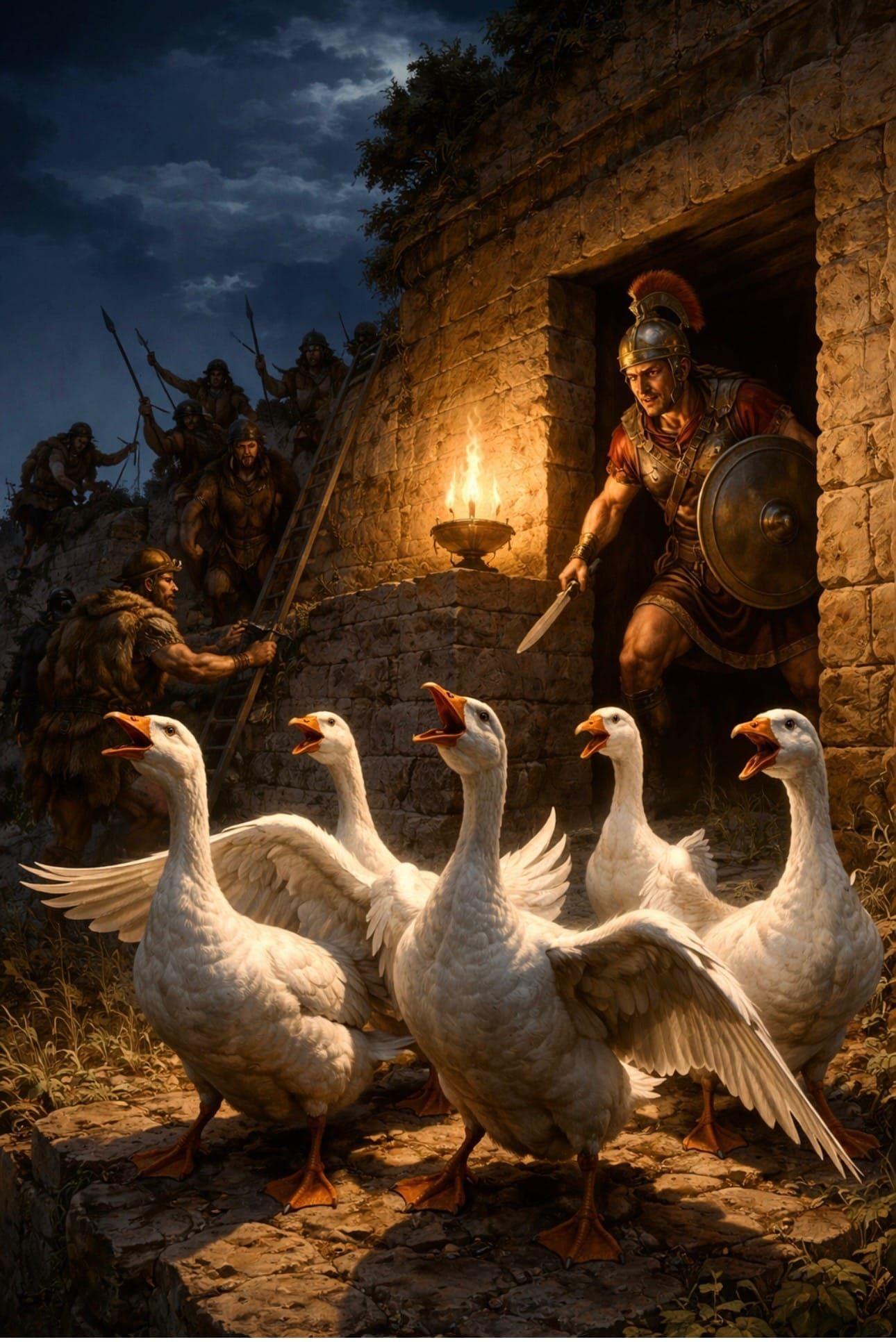
Likewise, the sacred geese who made their cries heard at the eleventh hour at the Citadel on that fateful day the Gallic horde scaled the walls in an attempt to seize control of Rome’s epicentre, roused the sleeping soldiers and ultimately inspired one of Rome’s greatest generals to save the day.
Here I present that article with minor edits and updates to bring it in line to January 2026.
Who would have thought that quacking geese could help save the Roman Republic from a Gallic horde in 390 BC?
It prompts the question: could a stirring speech on liberty help save Australia from its government in 2023 AD?
The Roman Republic was born when a warrior gathered his family from the ashes of Troy and founded a city destined to become one of the greatest civilisations in history. But its emergence was not without repeated struggles.
Grappling with rapid growth and accumulated power, the Republic was in danger of being crushed by Gallic invaders. Rome had conquered most of her neighbouring Italian lands, but chronic infighting among the Senate and Tribunes distracted it from the rising threat outside the empire.
In a final siege to sack Rome, Gallic troops climbed the Citadel wall, which was minimally defended as an exodus to neighbouring provinces had occurred. The people slept. Not even the dogs were alerted. It took the screeching of sacred geese to wake the people from their slumber and quickly act to repel the enemy.
Australia in 2026 is facing its own enemy at the gate. It goes by the name of Government. But it is not just my nation. The entire western world is now under serious threat from globalist outfits such as the United Nations, World Economic Forum, and World Health Organisation issuing edicts against the sovereignty of our democratic nations and stifling the liberty and freedom of citizens.
The government’s surveillance tentacles are reaching so far into our lives that we soon may not be able to breathe without its consent. Citizens are facing censorship of their thoughts, speech, and actions through various pieces of legislation that all seek to silence us with Digital ID lurking around the corner.
While we don’t suffer from screeching geese in our parliaments – albeit some may like to draw a comparison – our representatives are in a prime position to sound the alarm.
In the Parliament of New South Wales, on 28 June 2023, a newly elected MP laid down the stakes for liberty, delivering a rousing endorsement of the natural rights and abilities of the people, and a scathing assessment of government interference.
In his maiden speech, Ruddick articulated the essence of free market capitalism:
“We believe in the inherent morality of capitalism simply because, that is what people will spontaneously do when left alone. The worst atrocities of history were not the result of drought, flood, pestilence, or plague but of big government throwing its weight around like an elephant stomping on ants.”
One would think such a passionate defence of liberty would be welcomed in a democratic nation.
Alas, YouTube swiftly took it down.
Was it the mention of “anarcho-capitalism” that offended the senses of the censorship tzars? Perhaps too radical an idea for our modern and progressive world to embrace. Sadly, this term is misunderstood. Where it is demonised as being violent in meaning and action, it is really the opposite.
As Mr Ruddick said:
“Anarcho-capitalism has a favourable view of human nature and an unlimited belief in our potential. I am increasingly attracted to the view that we will tap humanity’s highest potential via a government-free voluntary-based society.”
Great speeches won’t save a nation from ruin, but they can affect how people begin to consider the world around them.
Ancient historian, Livy, in The Early History of Rome, wrote of a warning which was ignored because it came from a plebeian of no consequence.
“The Gauls are coming!”
And they were. Gallic armies decimated vast swathes of Roman territory. But Livy tells us:
“Destiny had decreed that the Gauls were still to feel the true meaning of Roman valour.”
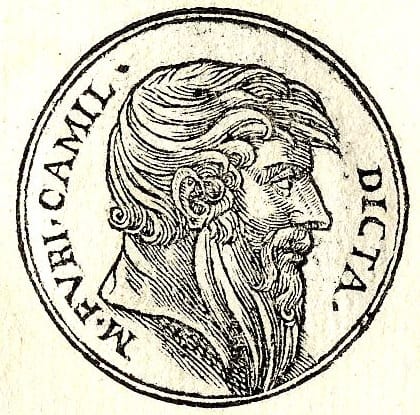
Marcus Furius Camillus led the army which would eventually end the Gallic invasion, and he was then tasked with rebuilding the Capitol. Within one year the new city was standing.
However, the threat of war from neighbouring peoples did not stop, and once again Camillus was elected as dictator because by that stage the Romans had “ceased to think lightly of any war,” as Livy tells us, and the firm hand of one leader was considered necessary.
With all the wars and rebuilding, a malaise had set in amongst the population. The people’s tribunes tried to attract crowds to their meetings by proposing agrarian laws, but by this time morale had waned:
"They made no great impression on the people, who were too taken up with their building to be often present in the Forum, and for the same reason were crippled with the expenses they had incurred and had little thought of land when they had no means of stocking it.”
Crippled with expenses – do I hear a familiar ring?
I refer to strength of leadership because it is critical in times of strife. Two thousand years on and the western world finds itself in such times. Yet, I look around and I find no Camillus to save us from ourselves.
Mr Ruddick delivered an inspiring speech in 2023 – a clarion call to serve as a warning for Australians in the face of monumental government overreach, reminding them of the value of our inalienable individual rights and freedoms, and how voluntary associations and agreements are by far the preferred mode of human interaction.
But where is Australia now almost three years on?
Sadly, in a far worse place politically and with even harsher laws limiting our freedoms.
However, in place of elected representatives, we should take heart that several western nations have their own “plebeians of no consequence,” as ordinary citizens take the lead to encourage people to take notice of what is happening to their human rights; the authoritarianism which is one small step away from full blown tyranny; and the corruption which is being exposed throughout government.
I realise this is an overused term, but it really is the only direct way to say it:
Politicians are meant to serve the People, not the other way around.
Too many have enriched themselves while the people’s standard of living has plummeted to unacceptable depths. Politics ought to be a “vocation,” not a career.
Whether it is possible to vote our way out of this mess remains to be seen. But if we are to honour what our ancestors gifted us by way of liberty, freedom to think and to speak, then we owe it to them and to those yet to be born, to defend it.
Rome’s greatest politician and orator, Cicero, said it best:
“Freedom will bite back more fiercely when suspended than when she remains undisturbed.”
If our ancestors had not stood up to the enemy, none of us would be here today.
Member discussion