‘Considering what has happened and is likely to happen, I want my views on peace published. And when I exhorted Caesar of all men to seek peace, I had no readier argument than to say, that peace became a man of his wisdom.’
- Cicero, Letter to Atticus, 49 BC
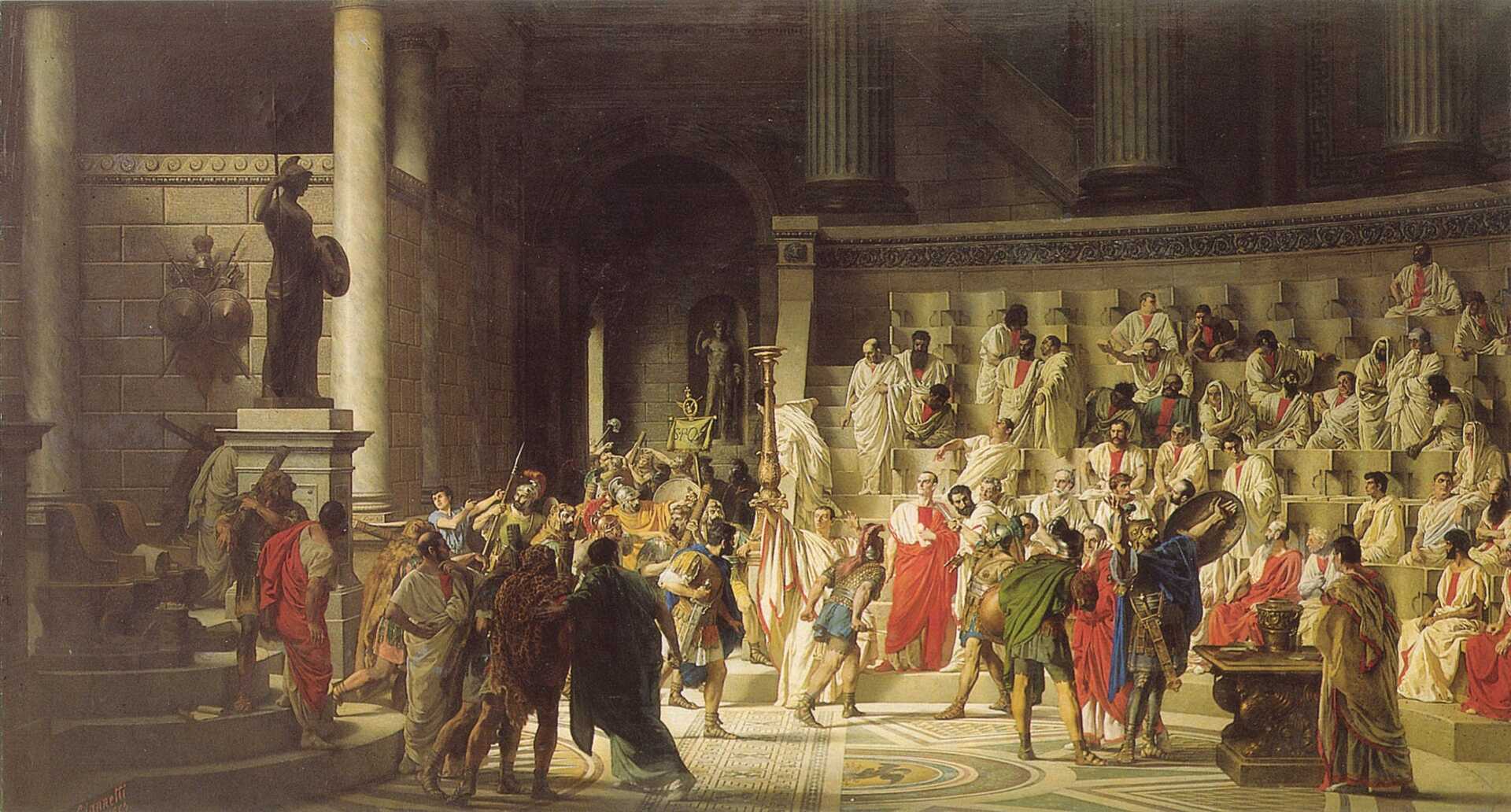
Caesar lay lifeless on the floor of the senate chamber after twenty-three stab wounds were inflicted upon him. Only the second one was fatal. The conspirators were keen to ensure the tyrant would die. The problem was that tyranny survived.
There was no contingency plan, and as a result, Antony and Octavian stood ready to assume Caesar’s place – the former as Caesar’s loyal lieutenant and sole consul, the latter as Caesar’s designated heir.
Cicero was not part of the conspiracy, but he was considered a ‘spiritual motivator,’ having long hinted at the evils of kingship and the legitimacy of tyrannicide.
Cicero initially considered that Antony would be ‘more concerned about his banquets than about plotting any harm,’ although he asked his good friend, Atticus, to ‘scent out Antony’s intentions.’
Those intentions yielded Cicero’s worst fears. He was about to embark on a vitriolic verbal assassination of the man he feared more than Julius Caesar’s veiled attempts to attain kingship.
Cicero was consoled by the Ides but laments the loss of reason that led to the republic not being rehabilitated. He laments the folly of taking a tactical rather than strategic approach:
‘So now I see it was folly to be consoled by the Ides of March: for though our courage was that of men, believe me we had no more sense than children. We have only cut down the tree, not rooted it up. So you see how it is shooting out.’
His contempt for Antony was only matched by his embrace of Octavian. Plutarch tells us that Cicero’s reason for attaching himself to Octavian was, ‘firstly, his hatred of Antony, and secondly, his natural passion for distinction,’ imagining that he was adding the young man’s power ‘to his own political influence.’
Cicero was on his way back from Greece to visit his son in July 44 BC when he was called back to Rome, on the premise that there was hope of negotiation with Antony. But when he did not attend the meeting, Antony was irate.
Cicero would emerge from a dark place to confront the man who he saw as the greatest threat to the Republic. He would change from a self-declared man of peace to an advocate for war.
Antony’s grave threats gave rise to the first of fourteen speeches, known as the Philippics. The First Philippic was generally considered a polite speech, but it is littered with more sarcasm and baiting than politeness:
‘Now what cause was there yesterday for me to be summoned to attend the senate in such harsh terms? Was I the only absentee? Has this body not often been less well attended? Was the business in hand such as to demand the attendance even of invalids? Hannibal was at the gates, I suppose; or peace with Pyrrhus was at issue…’
But it was the Second Philippic that is considered his masterpiece. It was never spoken in the senate, only written and not distributed until late 44 BC.
While he lamented that he had been excluded from participating in the actual event, he used his rhetorical brilliance to express his role as a spiritual participant:
‘If I had had a hand in the matter, I would have removed monarchy from the Republic, and not merely the monarch; and if the pen had been mine, as it is alleged, believe me, I would have finished the whole play, not just one act.’’
In a letter to a friend, Decimus Brutus, he said that preserving the liberty and welfare of the Roman people was paramount and that he [Decimus] was ‘not’ to await the sanction of the Senate which was still enslaved.
In his Third Philippic, he raised the spectre of tyranny, while almost pointing to a premonition of the Senate and the people’s demise:
‘You know Antonius’ insolence, you know his friends, you know his whole household. To be slaves to libertines, bullies, foul profligates, gamblers, and drunkards, that is the ultimate in misery joined with the ultimate in dishonour. if…the final episode i the history of the Republic has arrived, let us behave like champion gladiators: they need death honourably; let us, who stand foremost in the world and all its nations, see to it that we fall with dignity rather than serve with ignominy.’
By this time, Cicero has shifted from a man of peace, arguing that peace was no longer possible. He urged the Senate to look to their responsibility and suppress the rise of tyranny. It must have been a relief for him to feel the passion of being able to speak freely.
However, the price he paid for investing so much hope in the young Octavian proved to be his biggest error, as he assumed this young man had the loyalty of friendship and respect that Caesar had possessed.
With a newly formed triumvirate of Antony, Lepidus and the man soon to become Rome’s first emperor, Augustus, Cicero’s fate was sealed.
A list was drawn up of the names of more than 200 men who were to be put to death. Antony would only agree to terms if Cicero’s name was put on top of the list. Plutarch tells us that Octavian fought for two days to save Cicero, but abandoned him on the third day.
Cicero died on 7 December, 43 BC. Antony ordered his head and hands to be cut off, ‘the hands with which he had written the Philippics.
Caesar’s assassination did not give rise to rehabilitation of the Republic but was instead replaced with chaos. While life did not reward Cicero with the realisation of his dream, posterity did offer some compensation. When Octavian finally defeated Antony, he stripped him of all honours and chose Cicero’s son, Marcus, to be his fellow consul:
‘In this way Heaven entrusted to the family of Cicero the final acts in the punishment of Antony.’
The guardian on the watchtower had remained vigilant.
Conclusion:
Civil war in 49 BC changed the political landscape for Cicero and his fellow nobles. Caesar became dominant and Cicero pushed back on the rise of tyranny.
While the two men were at opposite ends of the Republican cause, they shared a mutual respect for one another’s abilities.
The Philippics were Cicero’s weapons to inflict injury upon Antony, whereas he adopted a more paternal approach to Octavian in one last attempt to exert the influence he tried unsuccessfully to wield with Caesar.
Cicero’s relationship with Caesar changed dramatically during the period 47 - 43 BC. He summoned strength to continue to fight for his ideal constitution from the ashes of personal tragedy and from hope of the great Roman past.
Caesar looms large as an enviable military and political giant, but both men enjoyed enough good will that Caesar was not without praise for the orator, saying that Cicero was the ‘winner of a great laurel wreath than that of any triumph, inasmuch as it is a great thing to have advanced so far the frontiers of the Roman genius than the frontiers of Rome’s empire.
Cicero died violently, lived precariously, and is remembered as a ‘learned man and a lover of his country.’
Member discussion