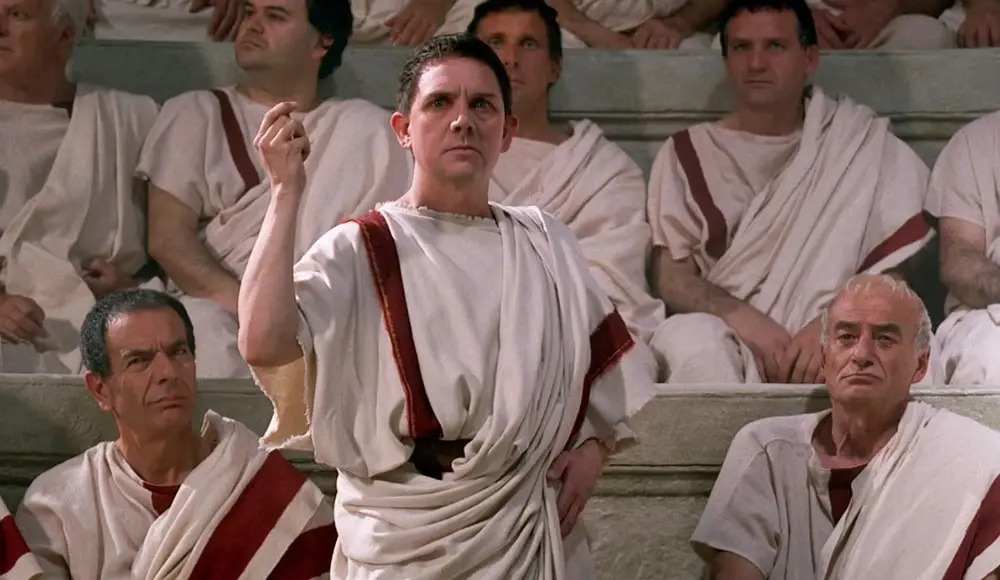
"I seemed to behold a vision of the Republic coming to life again!"
- Cicero, 46 BC
Caesar’s victory at Thapsus was too much for Cato, the Younger, who took his own life rather than accept a pardon from the dictator, so fierce was his opposition to the man who sought kingship. In contrast, Cicero would choose to live temporarily with Caesar’s autocracy, immersing himself in writing letters and liaising with friends about ways to position themselves for a restored Republic.
He may have chosen the wrong side of the Civil War, but he was intent on positioning himself as the saviour of Rome. He ingratiated himself into Caesarian favour, ever watchful of Caesar’s mood. But he did so from a position of what he describes as the “seething cauldron of affairs.”
Despite his character flaws, Cicero was the consummate politician – shrewd in his approach and dealings with Caesar’s allies. He played the game, writing to friends:
“I will never cease dining with those who have now the upper hand. What am I to do? One must move with the times.”
But he faces a dilemma with those times.
To deliver a fitting eulogy to Cato, a fellow staunch Republican, he would need to do so without raising the ire of Caesar. But he did defend his right to speak even in the face of censure. This response demonstrates his skill in manoeuvring around a difficult situation:
“It remains for me to say or do nothing foolish or rash against those in power…As to anything else, however – what so and so says I said, or how Caesar takes it, or how far those are honest in their association with me, who are assiduous in showing me courtesy and attention – of all that I can give no certain assurance.”
When accused of “playing the game” he challenges the notion that no one has yet come up with a better way. His reasoning was that he was protecting himself against dangerous days and admits he does not know the consequences of such a move but is prepared to stare down the challenge. In drawing a reference to Cato, he writes:
“But Cato, you will say, died gloriously. Well, it is open to me to do likewise whenever I so please, provided only I do my best to prevent its being as necessary for me to do so as it was for him; and that is just what I am doing.”
So much did he believe in the resilience of the Republic, that he began to mount a veiled defence of Caesar, telling his friends that while they each may be his slaves, he was himself a slave of circumstance.
One of the finest descriptions of the fight for Freedom ever to be composed is Cicero’s characterisation of Rome’s resilience:
“Freedom suppressed and again regained bites with keener fangs than freedom never endangered.”
The real opportunity, however, presented itself when Caesar granted clemency to Marcus Marcellus, regarded as one of the most stubborn of Pompeians, in September 46 BC. This was his chance to glorify Caesar and capitalise on his magnanimity. From his speech before the Senate, this reflects Cicero’s jubilation of hope revived, as he praises Caesar’s actions:
“For such humanity, such exceptional, nay, unheard-of clemency, such invariable moderation exhibited by one who has attained supreme power, such incredible and almost superhuman loftiness of mind I find it impossible to pass by in silence.”
He worked with the circumstances of the time, in the way which Cato had suggested to him at the start of the Civil War. Judging his grand oratory by our modern standards as being obtuse is puerile. Cicero was a creature of his times. He saw a vision of his Republica rising from the ashes and with it a renewed sense of hope, security, and dignity.
Alas, hope soon turned to disillusionment, with victory at Munda leading to Caesar possessing unrestrained power. Cicero’s dedicated commitment could not save the Republic now.
Member discussion