History is not merely a pastime. Not just a leisurely pursuit for those who have nothing better to do with their time. Nor is it a frivolous venture filled only with dates and timelines, facts and figures. It is an adventure. And that adventure begins with turning back to a beginning point of any given era or episode, for it is there we discover the most interesting and intriguing occurrences that ultimately shape the world we live in today.
The Roman historian, Titus Livius (Livy), wrote in the Preface to his major work, The Early History of Rome, that he accepted most people preferred to rush past the beginnings of a story, more eager to hurry toward modern times to discover what brought down one of the most successful empires of all time. But his feeling was different, explaining it this way:
‘I shall find antiquity a rewarding study, if only because, while I am absorbed in it, I shall be able to turn my eyes from the troubles which for so long have tormented the modern world, and to write without any of that over-anxious consideration which may well plague a writer on contemporary life, even if it does not lead him to conceal the truth.’
I share Livy’s interpretation, finding origin stories to be the most satisfying of all. Without the foundation, how can we understand the whole structure?
This applies most aptly to our contemporary world. If only more people took the time to read and grasp lessons from the past, see the patterns that repeat throughout time, and be prepared to apply them with seriousness, particularly as they pertain to government, our societies would be the better for it.
Australia is currently seized by a malaise of not knowing who we really are anymore. Once a land of aspiration, an easy-going lifestyle, a generous and happy people, and considered to be the “Lucky Country” (although that phrase has been misinterpreted – most people take it as a boast of fortunate privilege, when in fact it was coined as a warning about complacency and squandered opportunity).
Yet now we are caught up in a frenzied rush to attain global citizenship beyond our own unique sovereignty, and as a citizenry we were never consulted whether we wanted this. The spoiled fruits of this experiment are now on full display as this resource-rich nation has been left on the back foot, facing the prospect of running out of fuel supplies.
Not being able to drive as we once did will be the least of our worries if this crisis is not abated. Australia relies on our trucking industry to deliver supplies to farmers to grow their crops, feed their livestock, which ultimately becomes the food delivered to our markets and supermarkets. Without trucks, essential medicines and medical equipment do not reach hospitals and pharmacies; construction materials and concrete do not reach building sites; mining equipment and spare parts do not reach the pits and processing plants; and fuel itself does not reach regional depots, service stations, and generators that keep our towns, ports, and remote communities running. In short, the critical sectors of agriculture, health, construction, mining, energy, and retail depend on the convoys of drivers and diesel.
Now just imagine if the trucks stop running.
Reports are now coming through of some owners parking their trucks due to the mounting pressures on their livelihoods and devastating flow-on effects to the public, with one driver urging his colleagues in the industry to send a message to the government.
Modern Australia is as relevant to the ancient world and her problems as any other nation, because there we find the seeds of our development. Every contemporary society had its roots planted long before 2026. Dreams, aspirations, innovation and hard work fuelled the growth of Australia and every other highly developed country. No nation advances without the hard “yakka” by men and women who build societies from the ground up to become major towns and cities hundreds of years into the future.
It is called creating a foundation – one that must be solid, strong, and able to withstand the harsh winds of time. As a historian of the ancient world, I find no shortage of examples to draw from and lessons to learn by in my meagre attempt to present a way out of our own demise if only we would take the time and interest to do so.
Alas, our leaders care nothing for the history books. If they did, they would focus on ensuring Australia becomes self-sufficient in every way beginning with the lifeblood of a modern nation: secure, domestically refined fuel supplies and resilient, locally controlled energy infrastructure.
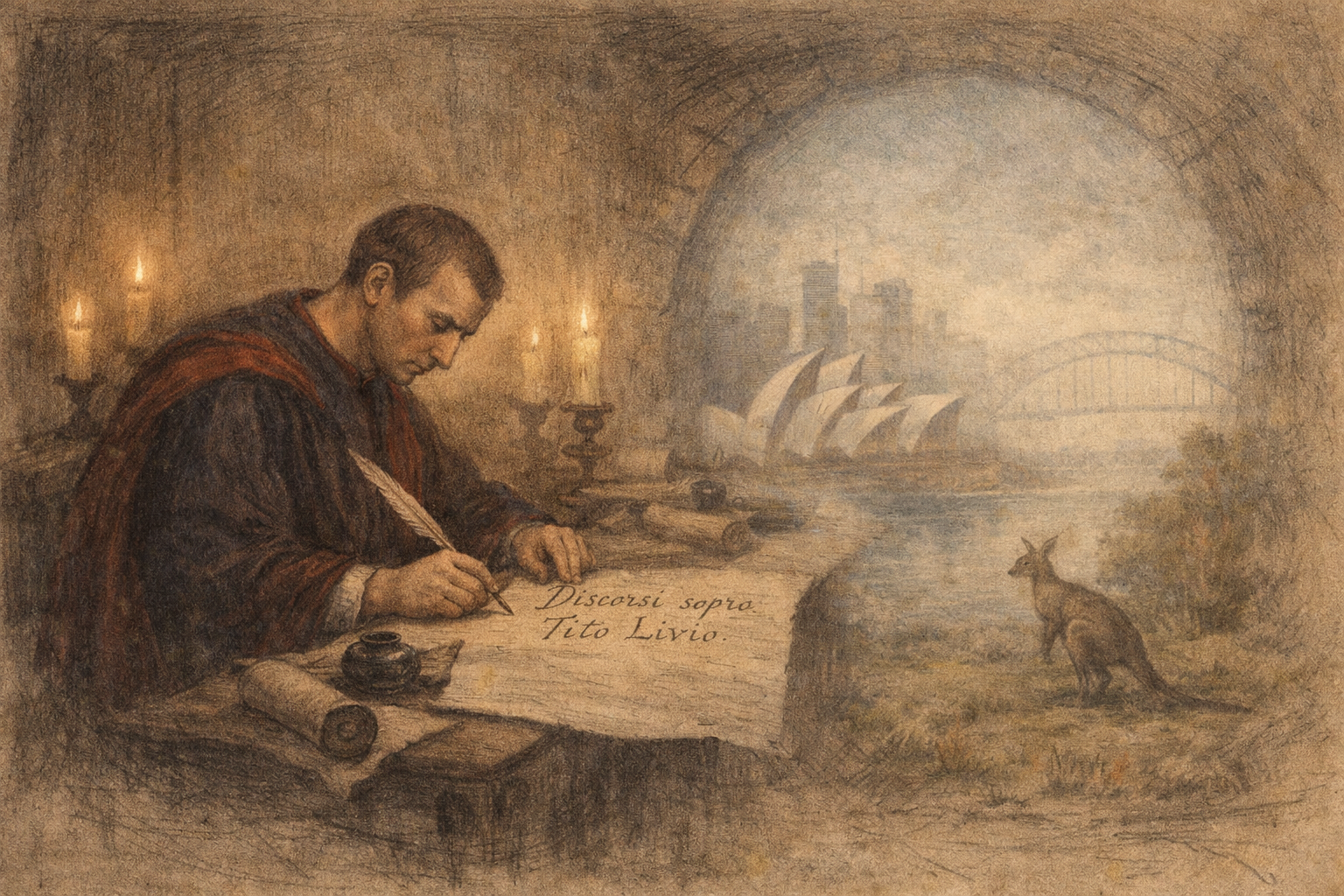
Niccolò Machiavelli wrote an entire Discourse on Livy’s work, so much was his admiration for the lessons that the ancient historian presented two thousand years ago before our own age.
Writing during the Renaissance, a period credited with a rebirth of classical thought, Machiavelli sought to inspire those who wished to enter politics to bear in mind the lessons of the past; that work would help plant the seed of modern political thought. He also advocated for looking back to identify beginnings, for it is there where we discover the same accidents occurring over and over, lessons which allow us to remedy contemporary dilemmas, and shape the future, if we dare.
‘Whoever considers present and ancient things easily knows that in all cities and in all peoples there are the same desires and the same humors, and there always have been. So it is an easy thing for whoever examines past things diligently to foresee future things in every republic and to take the remedies for them that were used by the ancients, or if they do not find any that were used, to think up new ones through the similarity of accidents.’
So much common sense that it is impossible to argue with it. Who would not want to know how to cure the maladies which ail us by looking at what worked or failed in the past? Yet I see no signs of a serious historical deep dive from where I sit in 2026; only chaos and confusion all around us.
Machiavelli goes on to explain the consequences of not doing so:
‘But because these considerations are neglected or not understood by whoever reads, or, if they are understood, they are not known to whoever governs, it follows that there are always the same scandals in every time.’
There is no excuse for a lack of access to lessons from the past in our modern age. Yet, the mistakes, the scandals, the whole crumbling edifice of disasters continue to repeat across time.
It is as though we have no immunity to ignorance and incompetence.
I look forward to you joining me at my newly-created website: https://www.letters-from-time.com/
There are many more articles of interest, covering varied areas of history, literature, myth and legend.
Member discussion