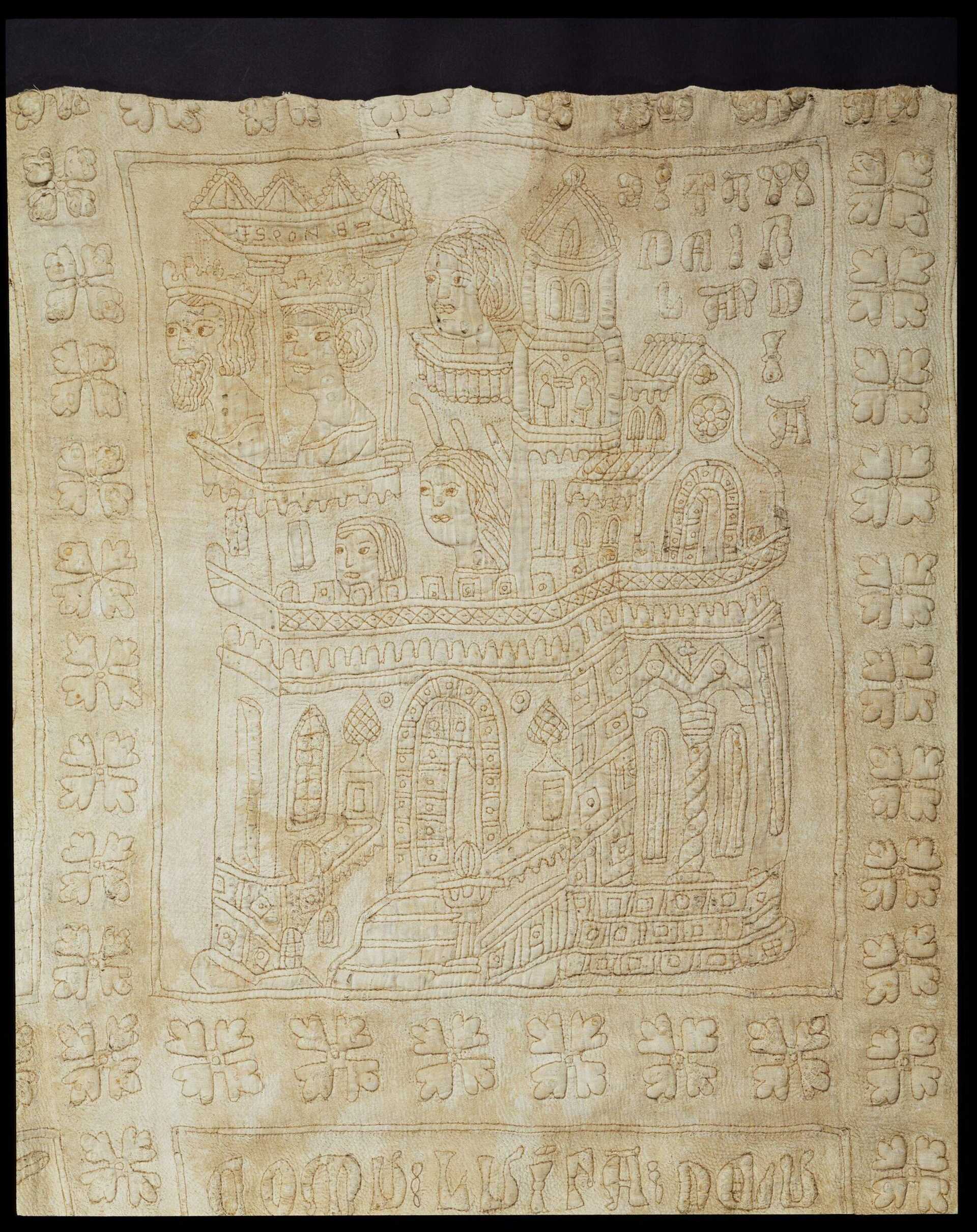
Image: Quilted bedcover with scenes from the legend of Tristan, Sicily, about 1390, courtesy of Victoria and Albert Museum.
We tend to think of words, buildings, paintings, mosaics, pottery, numismatics and inscriptions through which to understand or interpret history. Yet, there is another medium not well known of or referred to by historians – the humble Quilt.
I recently completed a handmade quilt which I began twenty years ago when my children were young. Family, work, and study took prominence until I finally picked it up and put the finishing touches to what is now a completed work of my own art.
As I observed it over a couple of days, it was not the wondering of why it took me so long to finish that occupied my thoughts, but how it invoked a reflection of history with all its intrigues.
With the project before me I could not resist the temptation to draw links of how cutting up a whole swathe of fabric into tiny remnants only to sew them back together, laying the newly created pieces out and matching (or not) to other pieces, and creating sections connected to how I saw history as the same never-ending destruction, reforming and rebuilding of new societies.
When Cicero watched his beloved Roman Republic disintegrate in front of him in 51 BC, he lamented how it had been torn apart from neglect and the passing of time:
But though the republic, when it came to us, was like a beautiful painting, whose colours, however, were already fading with age, our own time not only has neglected to freshen it by renewing the original colours, but has not even taken the trouble to preserve its configuration and, so to speak, its general outlines.
He spent his life defending the decline in the hope of a restoration, but paid the ultimate price of his life for doing so.
Quilts, too, as in any works of art, are subject to disintegration. But their designs can live on through the restorative hands of those who seek to preserve what they once represented. As such is the case for our societies. We have been forming, destroying and rebuilding since the beginning of time, a process that is neither new nor remarkable.
As I began researching into the history of quilting, I discovered a most intriguing project from the fourteenth century – The Tristan Quilt, providence about 1390 from Sicily.
This beautiful work depicts the legendary story of Tristan, nephew of King Mark of Cornwall, as he does battle with Morold, champion of the Irish King, Languis. Fourteen scenes of battles, ships and castles are intricately worked by hand revealing one of history’s most loved tales of adventure and romance via a relatively unreferenced medium. Aside from the main point of this work, that being the oppression of Cornwall by the Irish, it is also the story which inspired Shakespeare’s Romeo and Juliet.
Back to Ancient Rome now and you may wonder what the Fall of the Roman Republic in the late first century BC has to do with the reconstruction of a quilt design from 1850 AD that was reproduced in 2025 AD. Two words – durability and beauty. That which describes and bolsters the argument for the things that are worthy of saving and restoring.
The Latin word for quilt is culcita – meaning a stuffed sack.
That is what a quilt is – the binding together of two outside layers of fabric insulated by a more durable and warmer filling to provide warmth and comfort. Over time and with wear and exposure to the elements, it begins to deteriorate. It loses its once potent colours; it expands and pulls on the inside; and frays on the outside in much the same way as our well-developed fortified societies ultimately do. It does what Cicero’s Rome did.
In my completed quilt I saw the seeding and development of Rome, the city that would bear the name of her founder, Romulus.
- The planting of the seeds contained within the squares, representative of the laying of the foundations of what was destined to become the mightiest nation in the world.
- The strengthening of the city in the joining of remnant squares, indicating the building of alliances for support in the future when the seasons change.
- The building of a border, secured with one continuous vine, indicative of the strength of Rome’s leaders from then into the future.
- Finally, the complementary backing, required to fortify the entire structure.
And so a quilt tells a story – now in 2025 AD, and then in 1390 BC.
History lives in each of us and in how we can uniquely tell a story.
It would serve us well today to not only heed the lessons of the past, but look to all the forms of historical narrative on our way to defend, preserve and ultimately restore our own societies amidst the great turmoil we are currently living through.
Member discussion