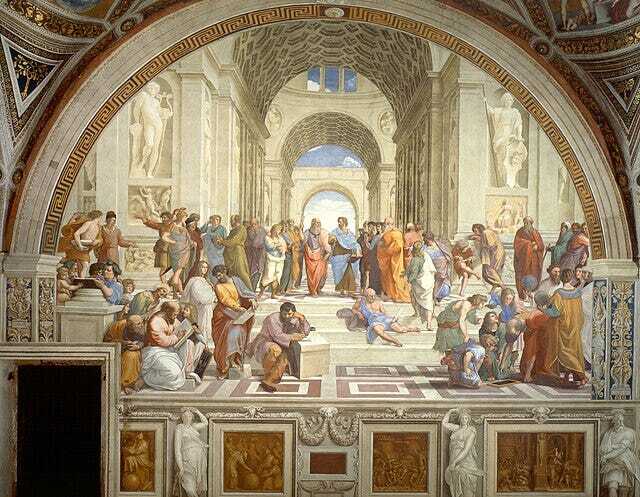
All around us it feels as though chaos and confusion is winning the day. It is hard to remain positive amidst the storm we are in, whether some of us wish to acknowledge its existence or not.
I don’t believe our world will descend into the abyss, but if we want our children and grandchildren to inherit a life which some of us once knew as more harmonious than it is now, we must find a way to build resilience in them.
My refuge is in books and the works of the great minds of antiquity. Sure, they weren’t perfect, but as the saying goes, I would rather spend time becoming acquainted with the people who built western civilisation than those who are seeking to destroy it. From the former we can derive a sense of serenity and hope rather than the latter who are selling dystopian, woke, soul-destroying nonsense.
I have resurrected some soul-enhancing wisdom from Plutarch, the ancient Greek essayist and thinker:
“But what happens at the moment is that although we do not expect a vine to produce figs or an olive to produce grapes, yet if we don’t have the advantages of both plutocrats and scholars, military commanders and philosophers, flatterers and those who speak their minds, misers and big spenders, all at once, we bully ourselves, are dissatisfied with ourselves, and despite ourselves as living deficient and unfulfilled lives.”
Plutarch wrote this 2000 years ago in relation to the human vice of expecting that life should deliver us every sort of happiness, prosperity and contentment with very little or none of the opposite. Clearly the ancients suffered from the same malaise and misfortune of not knowing one’s purpose in life as we do in 2025 – that of expecting we can all be famous singers, actors, artists, and billionaires.
Indoctrinating our children with the belief that they can conquer any aspect of the known world at any time, while lacking the skill and fortitude to do so, is foolish. Better to set them up to identify their own unique individual strength, and help them build resilience so strong that when misfortune arrives it does not necessarily mean they can’t continue, but that they can survive and adapt.
Tell them this, instead:
“Fortune, I have made a pre-emptive strike against you, and I have deprived you of every single loophole.”
Plutarch explains this as not being based upon any type of physical fortification as in locks and bolts, but upon principles and arguments that are available for any of us to call upon at any time.
He refers to the ancient Sicilian philosopher, Empedocles, who says that we are born with two dispositions or destinies:
“’Earth was there, and far-seeing Sun, bloody Discord and tranquil Harmony, Beauty and ugliness, Speed and Slowness, fair Truth and dark-locked Doubt.’
Consequently, since at birth we admitted, all together, the potential for each of these experiences, and since we therefore inherently contain plenty of inconsistencies, anyone with any sense prays for the better things, but expects the others as well, and copes with both sets by never behaving excessively.”
If we were able to impart ancient wisdom into the minds of today’s young, and foster it through continuity into adult life, our world could be starkly different from the current chaos modernity delivers and which spews forth meaningless fluff that will never set them up for survival in a world that Thomas Hobbes describes as often being “solitary, poor, nasty, brutish and short.”
Referring to where Plutarch says we do not “expect” that a vine will produce figs or an olive to produce grapes, as we know that they are subject to the unexpected and temperamental forces of nature, why then do we expect life to consistently deliver positive outcomes from our best laid plans for our lives?
In Plutarch’s words again:
“The point is that, if anything happens which may be unwelcome, but is not unexpected, this kind of preparedness and character leaves no room for ‘I couldn’t have imagined it and ‘This isn’t what I’d hoped for and ‘I didn’t expect this, and so stops the heart lurching and beating fast and so on, and quickly settles derangement and disturbance back on to a foundation.”
The term, ‘Wisdom of the Ancients,’ deserves a more prominent place in modern life, especially given that western civilisation gifted us the most spectacular works of art, music, buildings and thought.
Member discussion