“Now it is not without a definite purpose that I am reviewing events so ancient and remote, but I am taking my standards of character and action, to which the rest of my discourse must conform, from distinguished men and famous periods of our own history.” - Cicero.
That we need to look back into the distant past to find the remedy for our current ills is testament to how far humanity has strayed from its purpose.
Today, Western nations are hurtling towards a grim situation as together they face digital enslavement under the guise of “keeping everyone safe.” We have failed in our individual and collective duties to hold governments to account. They are truly off the leash with their increasing grip on us through new pieces of legislation, which is like a form of entrapment. Our representatives work against us, implementing legislation that we have no knowledge of or provide consent for, and who are cocooned in a bubble we refer to as “elites.”
Yet, none of this is new.
Look to Rome, hold a mirror up and see yourself staring back in different clothes.
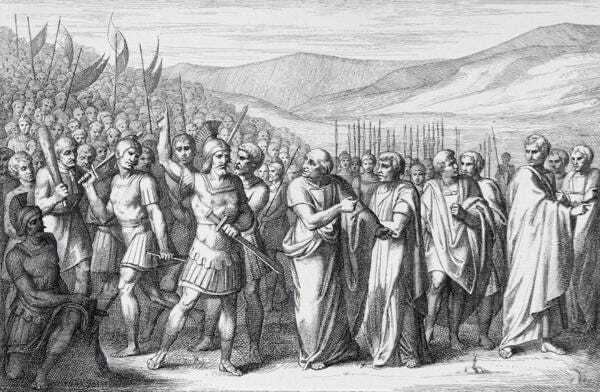
The time is 494 BC:
A mere 15 years after the fall of the monarchy and birth of the republic. The people have been pushed to the brink. Despite them fighting wars which resulted in successive military victories for Rome, they remained in a state of oppression. Their only hope for some relief was through the dictator, Manlius Valerius, who was appointed to the traditional and extraordinary office by the Senate on account of his moderate temper. He had the ear of the people and he had promised they would be rewarded for their commitment.
However, the state was troubled by enormous debt, and the ordinary Roman lived under a suffocating blanket of poverty. Desperation forced the plebeians to head for the hills outside the city, where they formed their own political organisation, known as the concilium plebis.
A political struggle ensued, but the elites, which included the influential financiers, were not about to give ground to the common man. Livy tells us:
“In spite of this triple military success, both parties in Rome remained as anxious as ever about the issue of the political struggle, for the money-lenders had used all their influence and employed every device to produce a situation which was not only unfavourable to the commons but tied the hands of the Dictator himself.”
Secession of the Plebs – secessio plebis
Through their defiance of oppressive senatorial dictates, ordinary Romans created a situation where two of their own would now represent them in the forum. It wasn’t until 287 BC, after subsequent secession episodes, that the plebeians gained full authority within the political process, which meant that Senate approval was no longer required for a tribunician bill to be enacted.
Resolutions of the tribunate were known as plebiscites. Initially, these were only binding on the plebeians, but with the passing of the Lex Hortensius in 287 BC, it became binding on all Roman citizens.
Fast forward 2300 years, and it needs to be asked, why are plebiscites no longer binding in a modern democracy such as Australia?
Our nation had a plebiscite in 2023 to vote on a Bill that would change our constitution by granting indigenous Australians a separate voice in our parliament. The overwhelming majority in every state voted NO. Yet, on November 13, 2025, the state of Victoria ignored the will of the people and legislated a treaty with Victoria’s indigenous population. It is said that other states will follow.
How do we function as a democracy if the will of the people is so blatantly ignored?
And we dare to cast aspersions on the ancient Romans and Greeks as being “antiquated” in a derogatory sense.
Commitment to rural areas:
In contrast, the “antiquated” Romans stood by the result of their plebiscites. In addition, they were committed to proper representation of all citizens, particularly those in rural areas, who were unable to come to the city for political and civil discussion (this is a topic for another time).
Here in Australia, in 2025 AD, the only commitment our government has is the binding one with international renewable energy companies who are destroying prime agricultural land across this nation to build wind turbines, solar farms, and battery storage facilities. All while our farmers are being denied any right of resistance, with many being ruined financially and run off their land if they do not comply.
What is the link that connects this long period in time, where the people had to consistently fight against senatorial control?
Indebtedness.
Sound familiar?
We have devolved, and yet, the chattering classes dare to refer to us as “progressive.” In this “progressive” modern age, the people are not represented by those who sit comfortably in leather-bound seats in our parliament. Instead, their prime loyalty is with Party and perks.
For the vast majority of politicians, it is “party first, constituents second.”
What Representation is meant to mean for everyday people:
Cicero tells us:
“Unless there is in the State an even balance of rights, duties, and functions, so that the magistrates have enough power, the counsels of the eminent citizens enough influence, the people enough liberty, this kind of government cannot be safe from revolution.”
The plebeian tribunes were chosen to counterbalance the power of the consuls – as today’s Members of the House of Representatives, or Congress in the United States, would counterbalance the Senators. But it does not work this way. Instead, they work in collaboration with their Party.
Party loyalty first. Constituency second.
Even Cicero, a novus homo – self-made man who relished his life as a Senator and valued the integrity of the Republic above everything else – recognised that without fairness and a degree of liberty granted to the common people, the Commonwealth could not stand:
“When the plebeians have been so weakened by the expenditures brought on by a public calamity that they give way under their burden, some relief or remedy has been sought for the difficulties of this class, for the sake of the safety of the whole body of citizens.”
This approach applies equally today as we bear witness to the eradication of civil and human rights for the common man and woman.
Digital Dystopia:
The dogged pursuit by those who rule to enslave their fellow man within a digital prison is the sole focus of bureaucrats and politicians across the West. Should that occur, there will be no recourse for the common people. It is a warning as stark today as it was in 494 BC, when Valerius - the empathetic dictator - on his return from a triple military success, attempted to persuade the Senate to address the political struggle and turmoil among the people. Sadly, his motion was rejected, but his words echo through time so clearly that it is impossible to dismiss them as being irrelevant to our own plight:
“I stand for domestic concord. You will have none of it. But mark my words: the day will soon come when you will wish in vain for men of my way of thinking to plead the cause of the populace. As for myself, I will no longer frustrate the hopes of the citizens of this country; I will resign from my now useless office.
Two things made it necessary: war and our own political differences.
The wars are won, we have peace abroad; but here at home there are still insuperable obstacles to it. I prefer to meet the real struggle, when it comes, not as Dictator but as a private citizen.”
Let us take heart from the character and actions of those who have gone before us and who have faced monumental challenges to save their own nations. No, they did not all succeed – Cicero was unable to save his beloved Republic, with a new era of empire ushered in as a result of brutal civil wars brought on in no small way by the toxicity of identity politics. Not much changes in the grand scheme!
We must lay the stones that form the path upon which our descendants will walk in their pursuit to recover what was built by those with fortitude, courage, valour and honour.
Member discussion